I saw Impressive, Sincerely this past weekend. The synopsis of the play goes as such:
“Set inside a real bookstore, Impressive, Sincerely is a sharp, deadpan comedy about an American author who travels to a small German town where her failed debut novel has become inexplicably popular. Through a series of author events, she begins to suspect her translator of manipulating her conversations and of authoring a shockingly unfaithful translation.”
First of all, the most prominent thing about this play is the setting/set. As the synopsis suggests, the play is set in an actual bookstore, at P&T Knitwear Bookstore near Chinatown, NYC. I did anticipate some of this setting, since I was aware that the bookstore has a stage and stairs facing it. Spacious and beautiful, P&T Knitwear Bookstore is the perfect venue for the play.
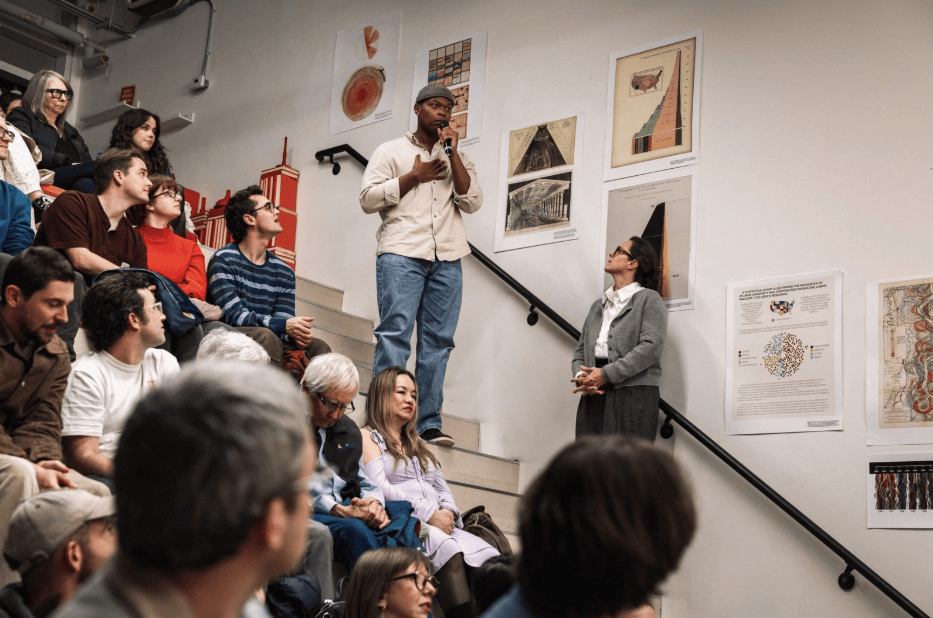
(Photo from https://impressivesincerelyplay.com/)
The book event part of the play made me feel like I was at an actual book event, listening to the smart or stupid or infuriating questions raised by the readers.
As language nerd, I fully felt the “lost in translation” aspect of communication. Even though the audience hears every dialogue in English, the characters, in their reality, are speaking different languages. When Madison, the American author, talks with Martha, a sort of liaison between the German publication and the author, they speak English to each other on stage, but in fact, one is speaking English and the other German. These are the only two main characters who can only speak one language.
Whenever this happened on stage, I kept thinking of a sentence my writer and translator friend Sienna Liu once said to me: “Communicating with anyone, even if you’re speaking the same language, necessarily involves translation.” (I’m promoting my own interview column here.) This sentence always reminds me of the many people I’ve encountered in my life.
During the play, when the audience was understanding everything, Madison and Martha weren’t. Because of this premise, I didn’t once assume that the two could form an actual connection, despite the looks in their eyes. Later, however, we see Madison and Martha engage in a deep emotional exchange with each other. The scene almost feels romantic, as Madison quite frankly confesses that there might be a little crush. The two start letting out more feelings and truths about each other and about themselves as the scene deepens. While I loved this little romantic potential, it felt a bit ridiculous (in all the good ways!) to me, because how could you have a crush on someone when you don’t even understand them? It’s one thing to be understood (which might just be the hardest thing in life) but another to understand. If you don’t, how can you correctly and truthfully consume the content? The communication is entirely based on feelings, which is the most inward and self-centered thing we can have. (I didn’t say feelings are bad, just that they are entirely of our own, uncorroborated.) Madison is having a crush entirely on how Martha makes her feel, which mostly has nothing to do with Martha.
This scene made me think of my former best friend and her partner who, although speaking English with each other, do not share the same mother tongue. Their respective mother tongues come up quite often, when friends come to their apartment to visit, when on the phone… However, after almost a decade of living together, they are at a first-lesson-on-Duolingo level with each other’s native language. This always feels absurd to me, because how can you not be curious to learn each other’s first language? The loss of a word comes up frequently to me in conversations with anyone; sometimes I think of a phrase in three languages, and sometimes I think of nothing when I really need a word. The quirks and secrets of a language—how can you not be curious to learn about all of them? I would want to understand everything. Their communicating in English is a reminder that there is a side of the person entirely unknown to each other.
Arrogantly, in contrast, I started to learn Korean after I became a BTS fan last year. (At first, I didn’t think that I’d be a big fan, that it was just a phase, and I’d just look at their faces and listen to some songs. I then proved myself wrong.) The struggle first came up when I watched their game show, such as Run BTS. When the seven of them talk and laugh over one another, I got buried in the subtitles. Having learned languages my whole life, I knew that the subtitles weren’t translating everything, but I could only know that. By and by, I became eager to know every single word each member said. Although AI translation has enabled certain things (against my will, too), I want to interpret as well as express in their native language. To be honest, as a language nerd, I am almost in pain when I can’t read what the members write on Weverse. Although I’ve still a long way to go, I’m getting closer.
I don’t mean that I am better than my former best friend and her partner, only that we think very differently. (One might even argue that being a Kpop fan and having a life partner are two very different things, too.) When I read the same content in two different languages and find discrepancies, they are my interpretation, my added thoughts and personal preferences. I could still be misunderstanding the original author as well as the translator. Sometimes we go on living with another person while knowing nothing about them, and that can be enough for some. But I’d rather have more content and material to work with than base everything on feelings and translations.
Nonetheless, the connection formed between Madison and Martha is genuine, very much so to themselves. As the famous Maya Angelou saying goes, “I’ve learned that people will forget what you said, people will forget what you did, but people will never forget how you made them feel.” At the end of the day, the product we take away with is the interpretation of actual events, and if that interpretation is, on top of it, translated from something else, we are indeed toying with our own version of the truth. “[P]eople will forget what you said” because they aren’t listening in the first place. I’ve learned that for some, to feel is to understand.
The German Translation
Back to the play now. Another major part of the plot is the “unfaithful” German translation of Madison’s book by Peter. This Peter is basically a German version of 林少华 (Shaohua Lin, a famous Chinese translator of Haruki Murakami, has always added his own twist to the original Japanese. While we all have our own preferred translator of Murakami, we can all agree that Lin was relentless in his translation style. On a side note: many books in Chinese translation have a translator’s note almost as long as the book itself, and when this happens, you can be sure to guess the gender of the translator.) As we can only assume that the German version is a not a bad book, Martha is a big fan of Madison’s book. So when Martha tells Madison about her love for the book, in her native and only language German, whose work does she actually love?
While it’s up to debate (to the characters in the play) which version is a better story, I felt that this debate could be hashed out a bit further. There should be more issues pertaining to Peter’s behavior, but they aren’t explored during the play. While we do see both Madison and Peter question whether they are good writers or not, the play focuses more on the “spiritual” communication among the characters who don’t speak one another’s languages. Perhaps the point of the play is not to solve the mistranslation but to point out that it is always a possibility, more so than a correct translation.
Perhaps one of the most painful feelings is to sit in front of someone, look them deep in the eye, and not understand a word that comes out of their mouth. At least that’s what I felt after watching the play.